
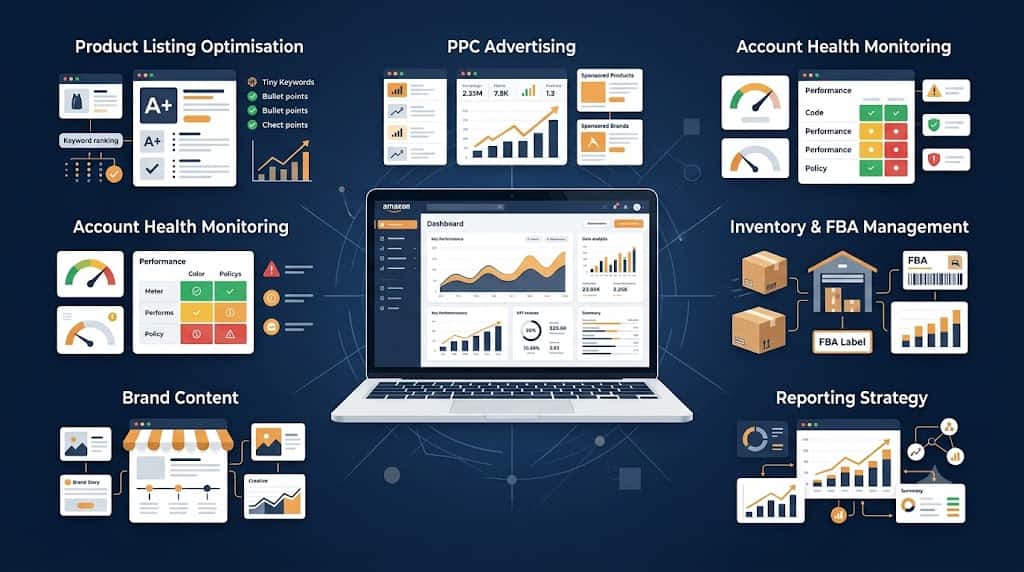
“Amazon account management” is a term that gets used loosely, which causes real problems when sellers start looking for help. Some agencies use it to describe a PPC-only service with a broader job title. Others use it to mean everything — listings, advertising, inventory, account health, brand assets, reporting — under one retainer. Knowing exactly what’s included before you sign anything is the difference between fixing your actual problem and paying to fix a different one.
This post is for sellers who are already selling on Amazon and are wondering whether the day-to-day operational weight of running the account is worth handing to someone else, and if so, what that should actually include. If you’re earlier in the process and still figuring out how to get started, our beginner’s guide to selling on Amazon UK is a better starting point.
What full account management actually covers
Properly structured Amazon account management has six components. Not every agency covers all six, and not every seller needs all six at the same time — but a service that describes itself as “full” should be doing most of them.
1. Listing management and SEO
Your product listings are the engine of your Amazon business. They determine organic rank, they influence conversion rate, and they feed directly into how well your advertising performs. Managing listings isn’t a one-time job — it’s an ongoing process of reviewing keyword rankings, monitoring what competitors are doing, testing copy changes, and making sure backend search terms remain relevant as Amazon’s search behaviour shifts.
Full account management includes the creation of new listings when you add products, optimisation of existing ones when performance data suggests they’re underperforming, and audit-level checks on a regular basis to catch suppressed, stranded, or incorrectly categorised ASINs before they cost you sales quietly. Our product listing team handles this as an ongoing activity rather than a one-off project, because a listing that was well-optimised in January may not be performing its best by June if the keyword landscape or competitor set has shifted.
2. PPC advertising management
Advertising is typically the component that takes the most time and has the most direct impact on both revenue and margin. Building a campaign structure, reviewing search term reports weekly, adding negative keywords, adjusting bids based on conversion data, and testing new match types and campaign types — all of that happens on a rolling basis, not just at setup.
Managing Amazon PPC well means treating the ad account as a live system rather than a set of settings you configured once and left. Bids that were right last month may be overpaying this month if a competitor has entered the space and driven up average CPCs. A search term that was converting at a healthy ACOS in March may have gone cold by May. The only way to know is to check, and checking takes time that most sellers running their own businesses don’t have in quantity. If you want to understand how PPC actually works under the hood before deciding whether to manage it yourself or hand it over, our complete Amazon PPC guide covers it in full.
3. Account health monitoring
Amazon tracks seller performance against a set of published thresholds, and falling below them can result in listing suppression, loss of Buy Box eligibility, or in serious cases, account suspension. The main metrics to stay inside are:
- Order Defect Rate (ODR): must remain below 1%. This covers A-to-Z Guarantee claims, credit card chargebacks, and negative seller feedback.
- Late Shipment Rate: must stay below 4% (applies to FBM sellers managing their own fulfilment).
- Pre-Fulfilment Cancellation Rate: must stay below 2.5%.
- Valid Tracking Rate: must remain above 95%.
Beyond these headline metrics, Amazon regularly issues Policy Notifications — warnings about specific listings that may have a compliance issue, a customer complaint, or an intellectual property flag. Left unresponded-to, these escalate. A good account management service monitors the Account Health dashboard daily, responds to notifications before they become enforcement actions, and handles the case management involved in resolving any that do get raised.
4. Inventory and FBA management
Running out of stock is one of the fastest ways to lose organic rank on Amazon — the algorithm treats a stockout as a negative signal, and recovering position after one takes time and ad spend. Conversely, sending too much stock into Amazon’s fulfilment centres and leaving it there too long incurs storage fees and eventually an aged inventory surcharge.
Full account management includes inventory forecasting based on your sales velocity and lead times, FBA shipment planning and coordination, and monitoring of your Inventory Performance Index (IPI) score — a composite metric Amazon uses to assess how efficiently you’re using their fulfilment capacity. Sellers with low IPI scores can face storage limits, which is particularly damaging if you need to stock up before a peak trading period.
5. Brand management and content
If you have Brand Registry, you have access to A+ Content (the enhanced image-and-text modules that replace the standard product description), the Amazon Storefront builder, and Brand Analytics. Managing these properly means keeping content up to date, ensuring your Storefront reflects your current product range, and using Brand Analytics data to inform both listing copy and ad targeting.
This crosses over into the creative side of brand development — and if your A+ Content is still the draft you put up at launch, if your Storefront hasn’t been touched since you built it, or if your brand assets don’t hold up against what your direct competitors are showing, those are fixable problems that account management should be picking up. The brand work itself — new creative, A+ modules, Storefront redesign — tends to sit as a separate conversation from the operational management, but the two are closely related: the account team should be flagging when brand assets need refreshing, even if the creative work is handled separately.
6. Reporting and strategy
The last component is arguably the one that separates account management from account administration. Good management means the people running your account are looking at data, drawing conclusions from it, and making proactive recommendations — not just sending you a dashboard and waiting for you to tell them what to change.
A monthly report should show you what happened, why it happened, and what’s being done about it. A quarterly review should include a forward-looking strategy conversation: which products are worth investing in, which are underperforming against potential, whether there are new keywords or campaign types worth testing. You can see the kind of commercial results that approach produces in our case studies.
What account management typically doesn’t include
This is important. Most agencies draw a line between account management and:
- Product development and sourcing — finding new products to sell, liaising with manufacturers, managing supplier relationships.
- Logistics and freight — arranging inbound shipping to Amazon’s fulfilment centres, customs clearance, dealing with carrier issues.
- Legal and compliance — trademark applications, regulatory compliance for specific product categories (cosmetics, electronics, supplements), legal disputes.
- External marketing — paid social, Google Ads, email marketing, and other off-Amazon channels.
Some full-service agencies do extend into some of these areas. Most don’t, and it’s worth getting clarity on exactly where the scope begins and ends before you engage anyone.
Signs it’s time to get professional help
The decision to bring in account management usually isn’t triggered by a single problem — it builds up gradually. The most common signals:
- You’re managing PPC reactively, not proactively. You adjust bids when you notice ACOS has crept up, not before it does.
- Your listings haven’t been properly reviewed in more than three months.
- You’ve had an account health notification you didn’t respond to quickly enough, or you’ve had a listing suppressed and spent days trying to get it reinstated.
- You’re spending meaningful hours per week on Seller Central tasks that have nothing to do with growing the business — checking metrics, updating inventory, responding to buyer messages.
- You’re launching new products and the process feels like a scramble rather than a system.
- Your account is growing but you don’t have a clear picture of where the growth is coming from or how to replicate it.
What to look for when choosing an account management partner
Ask for specifics. What does the reporting cycle look like — weekly or monthly, and what does a sample report actually contain? Who manages your account day-to-day, and what’s their Amazon background? Do they work with accounts in your category, and can they show you results from comparable clients?
The scope question matters most: get it in writing, not just in a sales conversation. What’s explicitly included and what isn’t? What does an out-of-scope request cost, and how is it handled?
Our account management service covers all six components above — listings, PPC, account health, inventory, brand, and reporting — with a dedicated team that operates within your Seller Central account rather than working off screenshots and exports. If you’d like to talk through what that would look like for your specific account and catalogue, the best starting point is a conversation.
Frequently asked questions
How is account management different from just having a PPC agency? A PPC agency manages your advertising campaigns. Full account management covers advertising as one component alongside listing management, account health, inventory, brand content, and reporting. A PPC-only engagement improves ad performance but won’t fix a suppressed listing, catch an account health notification, or flag that you’re heading for a stockout.
How quickly will I see results from account management? The honest answer is that meaningful improvement typically takes 60–90 days. The first month is largely audit and structural work — fixing the things that are currently costing you money or holding you back. The second month is where optimisations start producing measurable results. Significant revenue growth from a standing start usually shows in month three onwards.
Can I keep some control of my account while using account management? Yes. Most sellers retain control of commercial decisions — pricing, which new products to launch, which promotions to run — while the agency handles execution and day-to-day operations. The level of day-to-day involvement is usually something you agree on at the start of the engagement.
Is it worth paying for account management on a small Amazon business? It depends on what “small” means. An account doing £5,000 a month with three products and a manageable catalogue can usually be run effectively without agency support. An account at the same revenue level that’s growing quickly, adding new products, or operating in a competitive category where PPC and listing quality are decisive may get more from professional support than it costs.
Want to know if your account is leaving money on the table?
The clearest way to find out is an account audit — a structured review of your listing quality, campaign architecture, account health metrics, and organic rankings against what your competitors are doing. Get in touch and we can tell you quickly whether there’s a meaningful opportunity to improve on what you’re already doing.