
The most common financial mistake on Amazon isn’t overspending on advertising or ordering too much stock. It’s underestimating what Amazon takes from every sale before a penny reaches your account.
Amazon’s fee structure is comprehensive, layered, and changes annually. In 2026 it changed more than usual — Amazon made what it described as one of its largest-ever fee reductions, cutting fulfillment fees across European stores by an average of £0.26 per parcel. Several high-volume categories also saw referral fee cuts. That’s genuinely good news for UK sellers. What’s less prominently advertised is that storage fees, return processing fees, and liquidation fees were selectively increased in the same announcement — and a new 1.5% fuel and logistics surcharge was added to all FBA fulfillment fees from April 2026.
The net result, per Amazon’s own figures: an average reduction of £0.15 per unit, partially offset by an average increase of £0.02 per unit from the selective increases, giving a net saving of roughly £0.13 per unit sold via FBA for most sellers. That’s meaningful at scale. It doesn’t change the fundamental point that you need to model your fee stack precisely before you commit to a product — which is what this post walks through.
If you’re still deciding whether Amazon selling is right for you, our beginner’s guide to selling on Amazon UK covers the broader picture. If you’re already past that stage and working on product selection, the fee stack section of our product research guide shows how unit economics fit into the validation process.
The six types of Amazon fees UK sellers pay
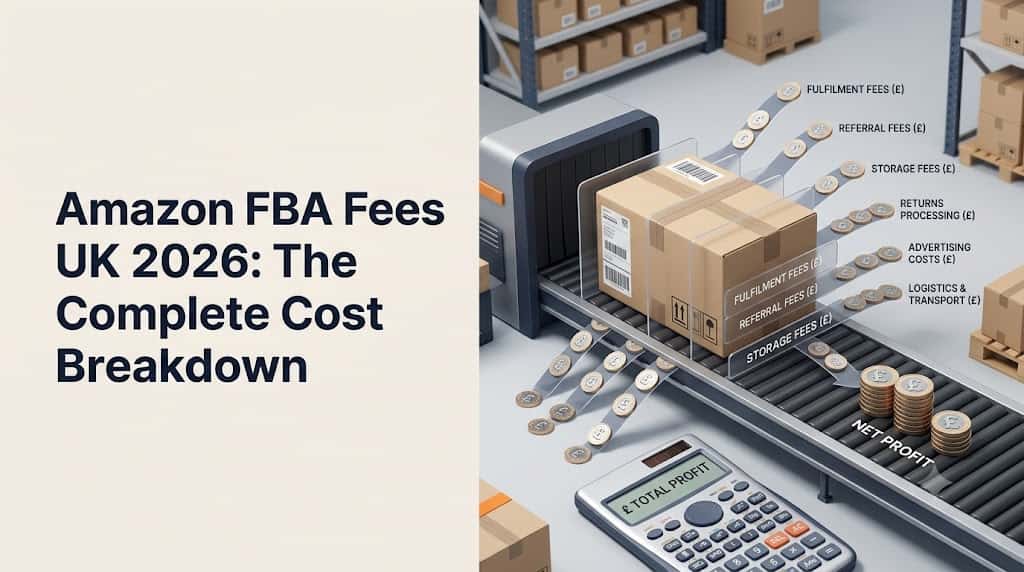
Amazon’s fees fall into six categories. Understanding what each one is before you look at specific numbers helps you model costs correctly rather than forgetting one and discovering the shortfall later.
- Monthly subscription fee — what you pay to have a seller account
- Referral fees — Amazon’s commission on every sale, regardless of fulfillment method
- FBA fulfillment fees — per-unit charge for Amazon to store, pick, pack and ship
- Monthly storage fees — ongoing charge for inventory held in Amazon’s fulfillment centres
- Aged inventory surcharge — additional penalty for slow-moving stock
- Returns and removal fees — processing costs for customer returns and inventory you want back
Let’s take each one in turn.
1. Monthly subscription fee
Amazon offers two selling plans. The Individual plan charges £0.75 per item sold with no monthly fee. The Professional plan charges £25 per month excluding VAT, with no per-item selling fee on top.
The maths is straightforward: if you sell more than approximately 33–35 items per month, the Professional plan costs less. More importantly, the Individual plan excludes you from the Buy Box — the primary “Add to Basket” button that accounts for the overwhelming majority of sales on any listing. For any seller building a real business rather than clearing out occasional stock, Professional is the correct plan from day one.
The £25 per month is also the smallest of the six fees for almost every active seller. It’s the one line item that’s easy to predict. Everything below is variable.
2. Referral fees
Amazon takes a referral fee on every sale. This is calculated as a percentage of the total sale price including any shipping charged to the customer, and it applies regardless of whether you use FBA or fulfil your own orders. There is a minimum referral fee of £0.25 per item in most categories, meaning even very low-priced items incur at least this charge.
The standard referral fee for most categories is 15%. But 2026 brought meaningful reductions to several high-volume categories:
- Clothing and Accessories: reduced to 5% for items priced up to £15, and 10% for items between £15 and £20 (was up to 15% for items in this range). Items above £20 remain at the standard rate.
- Home Products: reduced to 8% for items priced up to £20 (standard rate above £20).
- Pet Clothing, Food, Grocery, and Vitamins: reduced to 5% for items up to £10.
- Electronics: 8.16% for most products (the calculation is based on total sale price including VAT).
These reductions are material. A clothing item selling at £14.99 pays a 5% referral fee (£0.75) in 2026 rather than the previous 8% (£1.20). That £0.45 per unit difference is the kind of margin improvement that compounds significantly across volume.
The full, current referral fee schedule is in Seller Central under “Fees” and is the authoritative source — check it for your specific category and price point rather than relying on any third-party figure including this one.
3. FBA fulfillment fees
If you use FBA, Amazon charges a per-unit fulfillment fee that covers picking, packing, shipping, customer service, and returns handling. The fee varies by size tier and weight.
Amazon restructured its UK size tiers in 2025, so some products will have shifted tier since then — check your specific products in Seller Central rather than assuming last year’s fee still applies.
The 2026 direction of travel is lower fulfillment fees than 2025: Amazon reduced UK parcel fees by an average of £0.26 per unit in 2026 (on top of 2025 reductions). As a rough guide for planning purposes, current fulfillment fees for standard-size parcels in the UK run approximately:
- Small, light items (under 150g): roughly £2.50–£3.00 per unit
- Mid-weight standard items (150g–500g): roughly £3.00–£3.80 per unit
- Larger standard items (500g–1kg): roughly £3.80–£4.80 per unit
- Beyond 1kg: base fee plus a per-kilogram surcharge
These are approximate planning figures, not contractual rates. Use the Amazon Revenue Calculator in Seller Central for the precise fee on any specific ASIN.
Low-Price FBA: From January 2026, products priced at £20 or below qualify for Low-Price FBA rates, which are lower than standard fulfillment fees by approximately £0.40 per unit in most categories. This programme was previously limited to products priced at £10 or below. The expansion to £20 is a meaningful benefit for sellers in the £10–£20 price range who previously paid standard fulfillment rates.
Fuel and logistics surcharge: From 17 April 2026, a 1.5% surcharge applies to all FBA fulfillment fees in the UK. This is applied on top of the base fulfillment fee before any other calculations. On a £3.50 fulfillment fee, that’s an additional £0.05 per unit — small individually, but real at scale.
4. Monthly storage fees
Amazon charges a monthly fee for the cubic space your inventory occupies in its fulfillment centres. The UK fee structure operates in two seasons:
- January to September (off-peak): lower per-cubic-foot rate
- October to December (peak/Q4): significantly higher per-cubic-foot rate, reflecting the increased demand on fulfillment centre capacity during the pre-Christmas period
Storage fees were selectively increased in 2026 — the exact revised rates are in Seller Central’s fee schedule. As a planning principle: stock that sits in Amazon’s warehouses for more than four to six weeks costs you more in storage than many sellers account for in their margin models, particularly during Q4.
Practical implication: keep your restock quantities lean, particularly for new or unproven products. Sending in six months of stock before you know how the product performs is expensive if it doesn’t sell at the pace you projected.
5. Aged inventory surcharge
Any inventory held in an Amazon UK fulfillment centre for more than 241 days incurs an additional aged inventory surcharge on top of regular monthly storage fees. This threshold is not generous — at 241 days, a product that arrived in January will start attracting surcharges in mid-September.
Monitoring your inventory age report in Seller Central regularly, and either running promotions to accelerate clearance or requesting removal before the 241-day mark, is the practical defence against this fee. Removing inventory incurs a removal fee, but that fee is typically lower than the surcharge accumulated on slow-moving stock.
6. Return processing and removal fees
When a customer returns an FBA order, Amazon charges a return processing fee for product categories where free returns are offered to customers. Categories where customers currently receive free returns include clothing, shoes, jewellery, watches, and luggage — meaning the return processing cost is borne by the seller rather than the customer in these categories.
Return processing fees were increased selectively in 2026. For categories with elevated return rates — clothing in particular — this is a meaningful cost to model if you’re considering those categories.
Removal and disposal fees apply if you want Amazon to send your stock back to you (removal) or have it disposed of in their fulfillment centre (disposal). Both fees were also increased in 2026. Budget for removal costs when forecasting what it would cost to exit a product line or clear seasonal stock.
A worked example: the full fee stack on a £24.99 product
Let’s model a home accessories item — a small kitchen organiser selling at £24.99 on Amazon UK, fulfilled by FBA.
| Cost item | Amount |
|---|---|
| Selling price | £24.99 |
| Referral fee (15% — home product above £20) | −£3.75 |
| FBA fulfillment fee (standard size, ~350g) | −£3.45 |
| Fuel & logistics surcharge (1.5% on £3.45) | −£0.05 |
| Monthly storage allocation (per unit based on turnover) | −£0.25 |
| Total Amazon fees | −£7.50 |
| Cost of goods (factory price per unit) | −£5.50 |
| Inbound freight (sea, per unit allocation) | −£0.80 |
| Import duty allocation | −£0.40 |
| Packaging and labelling | −£0.30 |
| Total landed cost | −£7.00 |
| PPC advertising allocation (18% of sale price) | −£4.50 |
| Net margin | £4.99 (20%) |
At 20% net margin, this product is workable but not comfortable. The PPC allocation is the most variable element — if the product launches well and earns organic ranking, that 18% can fall significantly over time. If the category is more competitive than expected and CPCs run high, it compresses quickly.
The exercise also shows why the referral fee category matters so much. If this product fell under Home Products pricing and qualified for the 8% reduced rate (items up to £20), the referral fee would have been £2.00 rather than £3.75 — a £1.75 per unit improvement that would take this product from 20% to 27% net margin, a much more comfortable position. Pricing and category decisions are inseparable from fee modelling.
This is the kind of margin analysis we run as part of our full account management service — understanding the true unit economics behind every product in a catalogue, not just the gross revenue line.
The hidden costs that don’t appear in Amazon’s fee schedule
These aren’t Amazon fees, but they affect your net margin in the same way and are frequently omitted from beginner cost models:
Inbound freight: Getting stock from your supplier to Amazon’s fulfillment centres costs money. Sea freight from China runs roughly £0.50–£1.50 per unit for most small products. Air freight is 4–5× more expensive. Both need to be allocated per unit based on your shipment volume.
Import duty: Calculated as a percentage of the value of goods imported. The rate depends on the HS (Harmonised System) code for your specific product. Check the UK Global Tariff — it’s a free government resource at trade-tariff.service.gov.uk.
FBA prep costs: If you don’t prepare your inventory to Amazon’s labelling and packaging requirements yourself, you’ll pay either a UK-based prep centre (typically £0.30–£0.80 per unit) or your supplier to handle it at source.
VAT: If you’re VAT-registered — which is mandatory if you’re using FBA in the UK regardless of turnover — VAT is applied to your sale price and collected on Amazon’s behalf. Input VAT on your costs is reclaimable, but managing the cash flow and filing correctly requires either an accountant or compatible MTD-ready software.
Tools to calculate your fees accurately
Amazon provides two free tools in Seller Central that sellers should use for every product before ordering stock:
The Revenue Calculator lets you enter an ASIN or product dimensions and get a precise fee breakdown at your target selling price, including fulfillment fees, referral fees, and the net proceeds you’d receive.
The Fee and Economics Preview report shows your actual current fees across your existing catalogue, letting you spot where fees have changed and which products may have shifted into a different size tier.
Neither tool accounts for advertising spend, freight, or prep costs — you add those manually. But they give you the Amazon-side fees with accuracy that category-level estimates can’t match. For any product you’re considering seriously, the Revenue Calculator should be a mandatory step before you place a stock order.
Frequently asked questions
What percentage does Amazon take from each sale in the UK? Amazon takes between 8% and 15% as a referral fee for most categories (more for jewellery; less for selected categories with 2026 reductions). If you use FBA, add fulfillment fees on top. Total Amazon-side fees for a standard product typically run between 25% and 40% of the sale price when you include fulfillment and storage.
Did Amazon increase or decrease FBA fees in 2026? Both, depending on which fee you’re looking at. Fulfillment fees for parcels were reduced by an average of £0.26 per unit in the UK, and referral fees were cut in clothing, home, pet, grocery and vitamins categories. Storage, return-to-seller, and liquidation fees were selectively increased. A new 1.5% fuel and logistics surcharge was also added from April 2026. The net effect per Amazon’s own calculation is an average saving of around £0.13 per unit sold via FBA.
What is Low-Price FBA and do I qualify? Low-Price FBA offers reduced fulfillment rates for products priced at £20 or below. From January 2026, the threshold was raised from £10 to £20, making the programme available to significantly more sellers. Check Seller Central for the specific reduced rates applicable to your size tier.
When does the aged inventory surcharge apply? After 241 days in an Amazon UK fulfillment centre. Stock approaching this threshold should be either promoted to accelerate sales or submitted for removal before the surcharge kicks in.
Does Amazon charge fees on the full sale price or just the product price? Referral fees are calculated on the total transaction price the customer pays, including any shipping charge. If you charge £2 for shipping on top of a £20 product price, the referral fee is calculated on £22.
How do I find the exact FBA fee for my specific product? Use the Revenue Calculator in Amazon Seller Central. Enter your product’s dimensions, weight, and target selling price to get the precise per-unit fulfillment fee for your size tier. This is more accurate than any category-level estimate.
Want help modelling your margins before you launch?
Knowing your fee stack before you invest in stock is one of the most useful things you can do — and one of the most consistently skipped steps we see when new sellers come to us. If you’d like a second opinion on your numbers before you commit, or if you’re already selling and want to understand where your margins are being compressed, get in touch and we’ll take a look.